


They fail to stimulate defence innovators, support the development of new technologies, and prevent Ukraine from positioning itself as a reliable partner in international projects. Without a comprehensive reform that introduces the best elements of EU and NATO IP protection and innovation systems, the Ukrainian Defence Industrial Base (DIB) cannot develop or integrate into global markets. This is highlighted in the study, “EU/NATO Tech & IP Governance Models for Ukraine”.
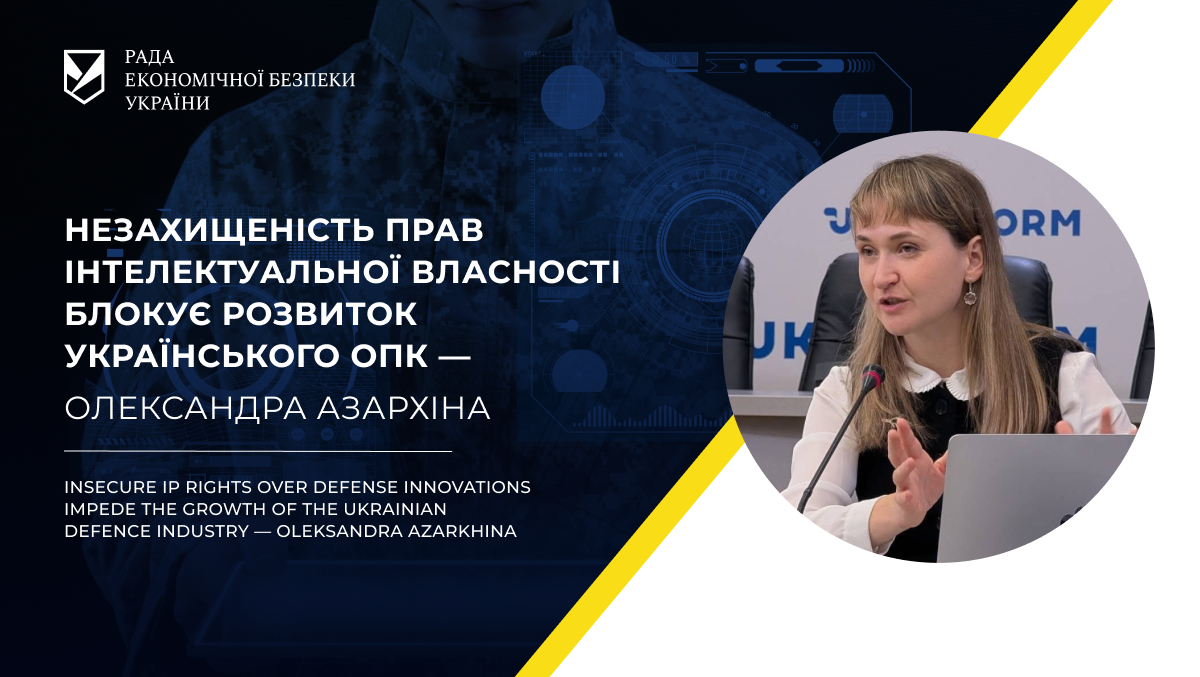
The presentation and expert discussion of the report's findings took place in Kyiv on November 25, moderated by Oleksandra Azarkhina, Head of Defence Industries Development at the Economic Security Council of Ukraine (ESCU).
Participants in the debate included: Kateryna Nalyvaiko, Head of the Intellectual Property Department at the Ministry of Defence (MoD); Oleksandr Hryhorenko, Head of the relevant Department at the National IP Office; Denys Dutchak, Partner at Truman Legal; Crispin Ellison, Partner at Oliver Wyman; Ihor Fomenko, Head of the Board at FEU Defence (Federation of Employers of Ukraine); Serhiy Honcharov, Executive Director at NAUDI; Anna Zarudna, Head of Government Relations at the Tech Force in UA; Alina Podolieva, Head of Intellectual Property at the BRDO Regulatory Policy Sector; Marta Bukhtiyarova, Head of Research in the Defence Direction at KSE Institute.
“Although our technologies are battle-proven, they will not attract billion-dollar investments or achieve mass scaling until an effective intellectual property protection system is in place. Already, one-third of defence manufacturers have relocated their enterprises abroad. This is not just about economic losses; it poses a direct threat to the country in a technological war of attrition,” warned Olexandra Azarkhina during the presentation of the study.
Due to the lack of a unified IP approach, some developers are already registering patents in the US or EU countries. Consequently, technologies created in Ukraine transfer ownership to other nations, and tax revenues leave the country.
“Ukraine has the potential to become one of the leaders in the global Defence market, but exports are impossible without a clear definition of rights to these developments. Innovations come at an extremely high cost to our country, and we cannot allow them to be lost,” emphasized Serhiy Honcharov, Executive Director of NAUDI, during the event.
The ESCU report highlights that IP terms in MoD contracts are either inconsistent or entirely absent, leading to a systemic failure where the state cannot rapidly scale successful military developments. At the same time, businesses fear investing in new technologies, risking the loss of rights to their own innovations.
“For our Western partners, robust IP protection is not a formality; it is a key prerequisite for technology transfer and the creation of joint ventures. Without it, we will not gain access to the critically important foreign developments necessary for our victory,” added Ihor Fomenko, Head of the Board at FEU Defence.
The optimal solution for Ukraine must be a management model that ensures industrial competitiveness and secure integration into Euro-Atlantic structures. ESCU propose borrowing from the EU a market approach to innovation stimulation, contractual discipline, and clarity in IP definition. From NATO, they recommend adopting the protection of sensitive technologies, unlimited government usage rights, and ensuring compatibility with export control regulations.
“Ukrainian IP norms do not meet modern market needs, which is why companies increasingly focus on predictable international protection mechanisms. We have a dual objective: to help manufacturers protect their developments within Ukraine and prepare them to meet international standards,” explained Anna Zarudna, Head of Government Relations at the Tech Force in UA.
Read the full study to explore the roadmap of necessary changes for the effective protection of intellectual property rights for defence technologies.