


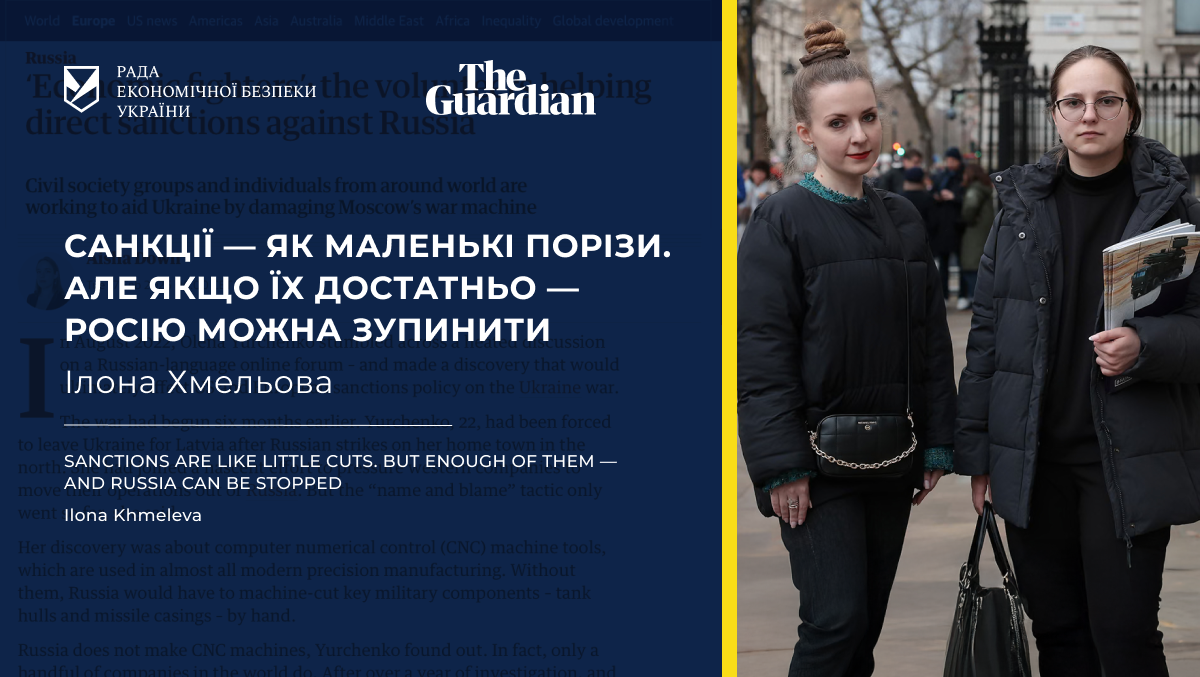
"Their effects are not immediate, unfortunately. If we have sanctions today, we'll see the results next year. The problem is that sanctions are like little cuts. If you have a lot of them, you can stop Russia," said Ilona Khmeleva, Secretary of the Economic Security Council of Ukraine (ESCU) for The Guardian.
The publication calls ESCU one of the key organisations in a global network of "economic fighters" mapping the supply chains of Russia's war machine and driving sanctions designations.
In 2024, ESCU successfully lobbied for an EU ban on chromium exports to Russia — a metal used to plate artillery barrels. They were also the first to recognize the importance of computer numerical control (CNC) machines, without which Russia would have been forced to manually process key military components.
“Russians used to buy 70% of the CNC machines from the west. Now they are buying 80% of their CNCs from China. And these CNC machines are of a lower quality, bad precision, like a one-time razor,” explains Olena Yurchenko, Chief Analyst of the ESCU.
Denmark's sanctions coordinator confirmed that the majority of targeted EU sanctions packages were developed on the basis of research by organisations like ESCU.