


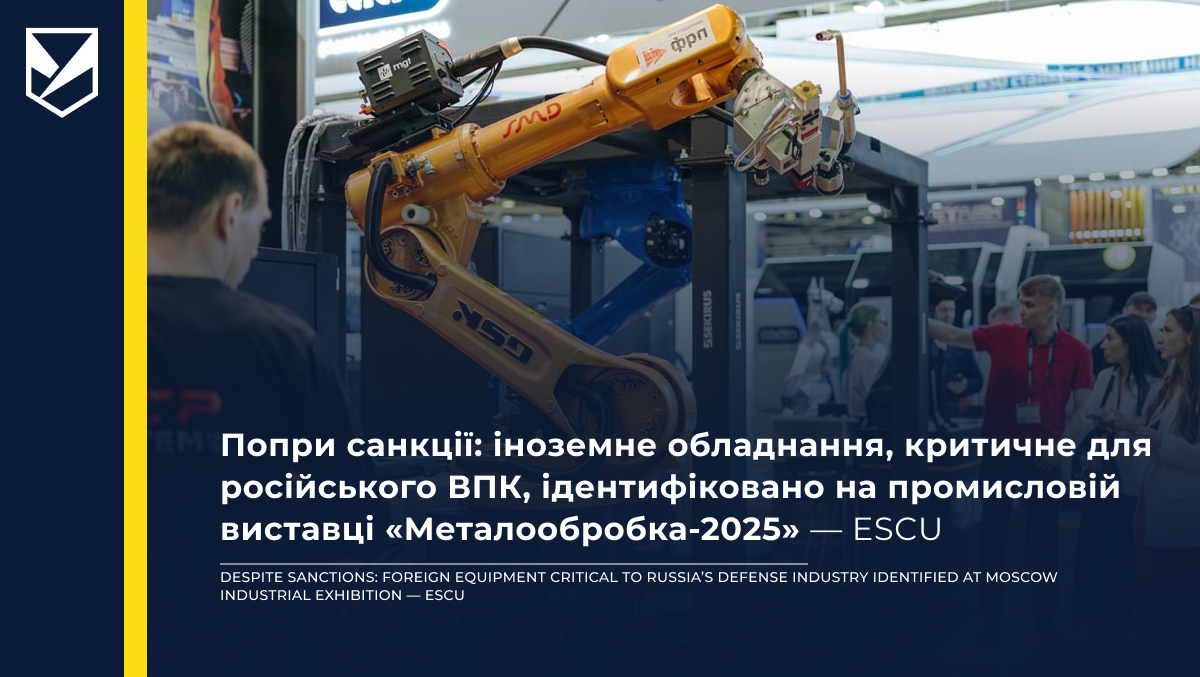
Equipment from 30 companies based in Turkey, Taiwan, Italy, South Korea, Germany, Austria, France, Japan, and the U.S. has been identified at the Russian industrial exhibition Metalloobrabotka-2025 in Moscow. Most of the 107 showcased product categories are directly or indirectly subject to EU or U.S. sanctions, primarily due to their critical role in Russian arms production, reports the Economic Security Council of Ukraine (ESCU).
In accordance with customs data for 2024–2025, ESCU analysts also verified shipments to Russia of equipment from 23 companies showcased at Metalloobrabotka-2025. Among the more than 1,700 shipments were Computer Numerical Control (CNC) machines, metalworking lines, hydraulic presses, control systems and control cabinets, servomotors and drives, Programmable Logic Controllers (PLCs), operator panels, precision measuring equipment, and related electrical components.
While most shipments to Russia were carried through intermediaries in third countries, analysts also identified over 500 direct shipments from 11 companies based in Turkey, Taiwan, Italy, and South Korea.
“Despite the Kremlin's significant shift toward Chinese manufacturers, products from Western brands continue to reach the aggressor state through third-party jurisdictions, with local resellers openly showcasing them at major industrial exhibitions, including for arms manufacturers. It is therefore vital that potential sanctions violations in EU countries are investigated by law enforcement agencies. This year, we have already witnessed large-scale raids on the offices of a German company, but this is still not enough,” noted Roman Steblivskyi, Policy and Advocacy Expert at the Economic Security Council of Ukraine (ESCU).
For the upcoming Metalloobrabotka-2026 exhibition, scheduled for May in Moscow, foreign brands—including those from G7 and EU countries—have once again announced their participation. Among them are 23 companies from China, 17 from Germany, 3 each from Italy and Switzerland, 2 each from Czech Republic and Taiwan, and 1 each from Slovakia, Denmark, the United Kingdom, and Japan.
Earlier, the Economic Security Council of Ukraine (ESCU) identified a critical dependence of Russian aviation—specifically Su-34 and Su-35S aircraft—on Indian fuel additives and natural rubber supplied from the EU.