


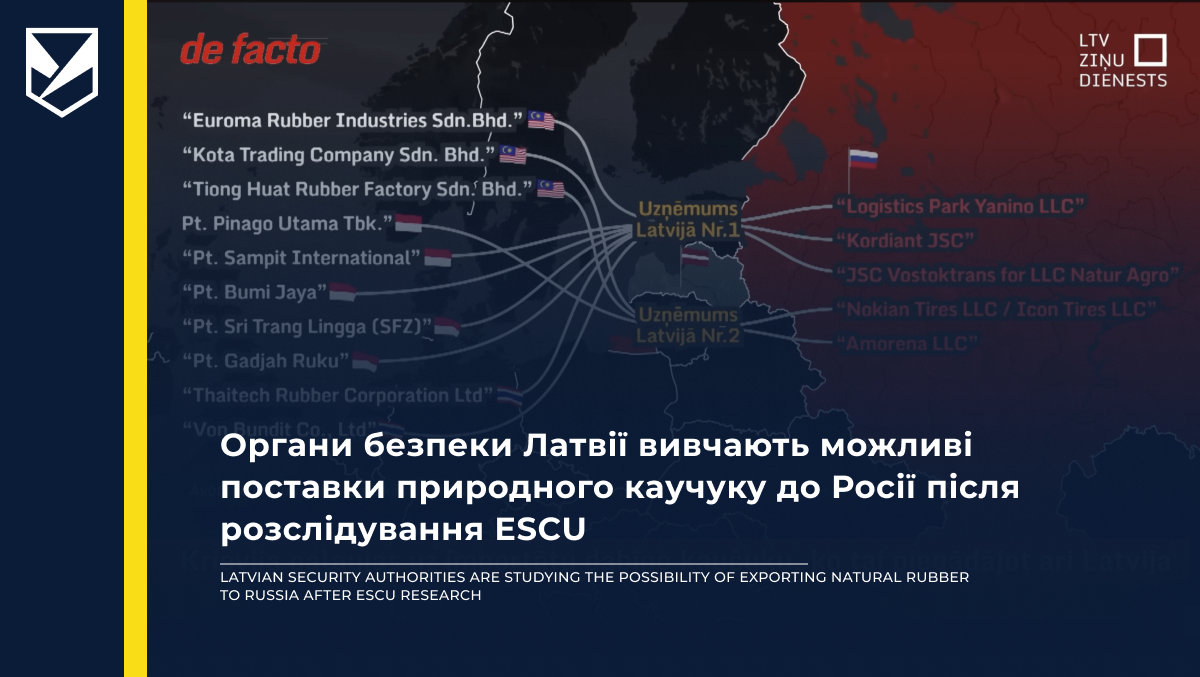
Latvia’s security services are examining whether natural rubber may have been exported to Russia via Latvian territory. The country will also insist on including this raw material in the next 20th EU sanctions package, Latvian Television (LTV) reports.
Last year, nearly 2,000 tonnes of natural rubber were shipped from EU countries to Russia, and 86% of those supplies transited through Latvia, according to LTV's De Facto program, citing an investigation by the Economic Security Council of Ukraine (ESCU). Latvia’s security services are also reviewing the findings.
“We have to find out whether there was a violation of EU sanctions or whether the supplies were directed straight to the military-industrial complex. Currently, we are awaiting the conclusions of our security services,” Artēms Uršuļskis, Parliamentary Secretary of Latvia’s Ministry of Foreign Affairs, told LTV. The security services’ conclusions are expected to be received within the next two weeks.
Russia is critically dependent on imports of natural rubber, whose properties cannot be fully replaced by synthetic alternatives. The material is also used by Russia in the production of tires for Su-34 and Su-35S fighter jets.
“European countries are not producers of natural rubber themselves, but since its export is not prohibited, they can serve as intermediaries,” Olena Yurchenko, Director of Analysis, Research, and Investigations at the Economic Security Council of Ukraine (ESCU), explained to journalists at LTV.
Unlike synthetic rubber, which has been subject to EU sanctions since 2023, natural rubber remains largely unrestricted. Latvia has already stated that it will insist on including this raw material in the next 20th EU sanctions package targeting the Russian Federation.
Earlier, the Economic Security Council of Ukraine identified a critical dependence of Russian aviation — including Su-34 and Su-35S aircraft — on Indian fuel additives and tires supplied from China.